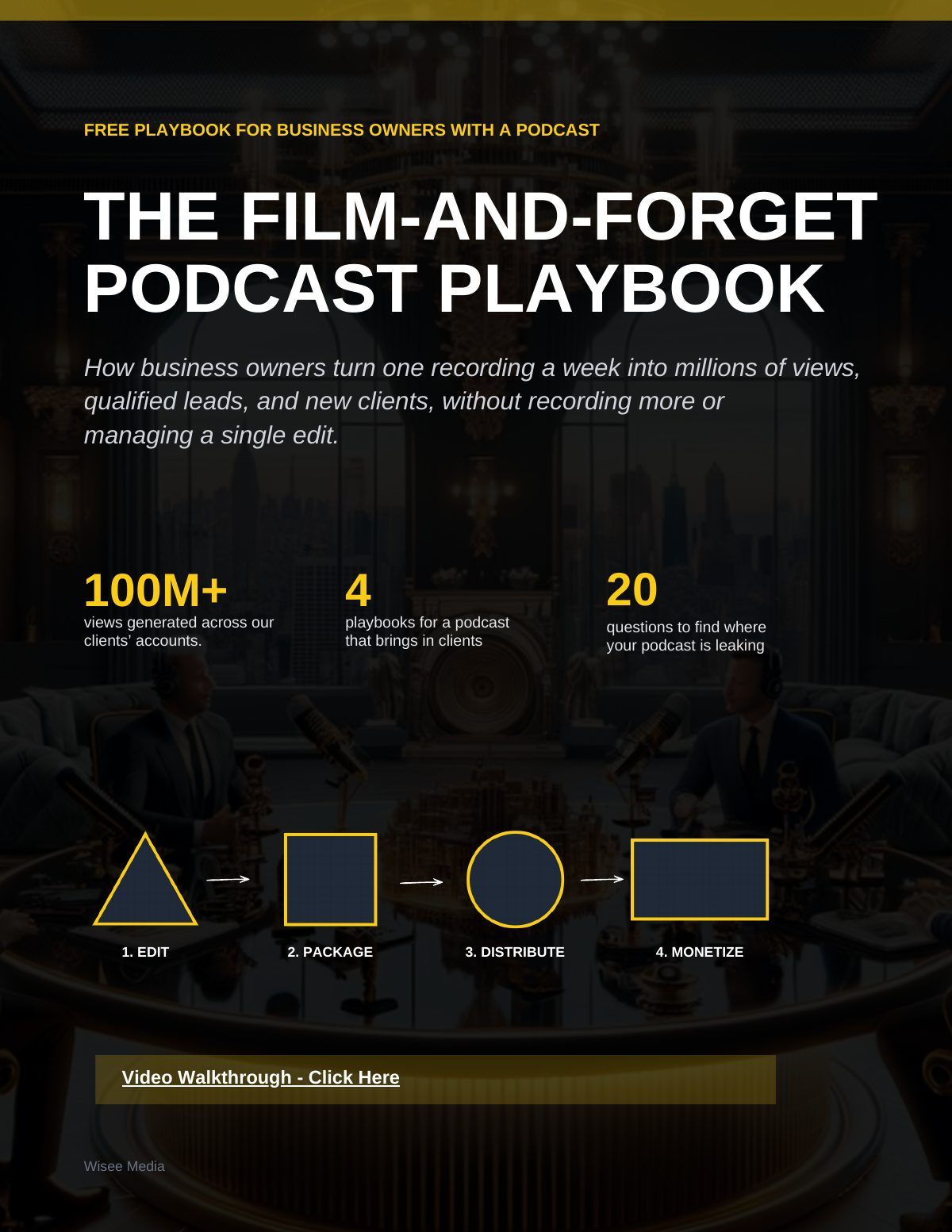
Start hereIs This Playbook For You?
This is for you if…
- You run a business and use a podcast (or want to) to win clients, not just fans.
- You have 25+ episodes published, so you have a back catalogue worth mining.
- You have an offer worth $2,000+ that the right listener would happily pay for.
- You want the podcast to run without you managing edits, uploads, and posting.
This is NOT for you if…
- You want overnight virality or don’t have a long-term approach to content.
- You have nothing to sell yet. Views without an offer are a hobby.
- You are unwilling to change your content, test new angles, or stay consistent.
Why Most Business Podcasts Don’t Bring In Clients
Most business owners think their podcast has a content problem. Usually, it has a system problem. The conversations are good. But the value leaks out at four points before it ever reaches a buyer:
| Leak | What it looks like | What it costs you |
|---|---|---|
| 1. Edit | Slow intros, tangents, and tech hiccups before the best insight | Viewers leave before they hear why they should trust you |
| 2. Package | Titles and thumbnails that describe the episode instead of selling it | Your best conversations get 400 views instead of 40,000 |
| 3. Distribute | One full episode posted once, in one place | Most of your ideal clients never find you |
| 4. Monetize | No clear CTA, or worse, a hard pitch nobody wants | Attention that never becomes a booked call |
Why I Built Film-and-Forget
I started Wisee Media in 2019 running one Instagram account, for Jake Ducey. Since then I’ve worked with more than 100 business owners and managed over 50 podcasts, and the same pattern showed up almost every time.
Most business podcasts have great conversations, but very few people see them because there’s no system for packaging and distribution. Episodes get recorded, posted once and disappear.
So we built Film-and-Forget: a system where you record one episode and go back to running your business, and a dedicated content team does the editing, packaging, distribution and social media work. Your only job is recording.
If you’re already putting time and money into your podcast, every episode deserves this system behind it. I’m giving away the full knowledge so you can use it. If you want our help to implement it for you, you can apply for a free audit.
— Binaya Gyawali, Founder & CEO, Wisee Media
A dedicated team per show
Your own content strategist and editor, who learn your show and your offer.
Long-term approach
We work with business owners who think in years, not months, and can film content consistently.
About 2 hours a week
We help you focus on your business by managing your content operations for you.
“Wisee Media is the best hiring decision I’ve made this entire year.”
Part 1The Post-Production Playbook
Turn raw recordings into episodes that earn attention, keep viewers watching, and make every minute feel worth it.
Why it matters: Most episodes lose viewers before the strongest insight appears. Long introductions, repeated explanations, technical interruptions, and unnecessary tangents are retention leaks. If a buyer leaves at minute 3, they never hear the part that would have made them trust you.
The 3 Plays
- Play 1: Create an unskippable trailer. Build a 30 to 60-second opening around the strongest moment in the conversation: a surprising statement, a bold question, an emotional story, or a meaningful result. Give enough context to care, but leave one question unanswered.
- Play 2: Remove retention leaks. Cut anything that doesn’t serve the episode’s main idea. Keep the personality: humour, reactions, disagreement, and meaningful pauses. The goal isn’t to make it artificially fast. It’s to make every moment intentional.
- Play 3: Add visuals with purpose. Use camera changes, images, chapters, and simple on-screen text only when they help. Ask of every edit: does this help the viewer understand the idea, feel the moment, or stay for the payoff? If not, cut it.
The 60-Second Trailer Script
| Time | Beat | What goes here |
|---|---|---|
| 0–10s | Hook | The single boldest line from the episode, word for word. No intro, no logo, no “welcome back.” |
| 10–25s | Context | Who is speaking and why they are credible (on-screen lower-third). One line on what the episode is about. |
| 25–45s | Stakes | 2–3 rapid cuts that raise the question: why this matters to the viewer right now. |
| 45–60s | Open loop | Cut right before the payoff. Host line: “We’ll get into exactly how in a minute.” Then start the episode. |
Example (real estate episode): Hook: “Most investors will lose money on this in the next 18 months.” → Context: “[Guest], who has bought 400+ rentals…” → Stakes: two quick clips on rates and insurance costs → Open loop: “And there’s one market that’s doing the opposite. We’ll get to it.”
The Retention Leak Cut-List
Run every raw episode through this before it goes to the editor. Tick what you find, then cut or move it.
- Anything before the first real insight that runs longer than 60 seconds
- Pleasantries: “thanks for having me,” scheduling talk, mic checks
- Guest bio read aloud (move it to an on-screen lower-third)
- Sponsor reads or housekeeping at the top (move after the first big payoff)
- Audio drops, tech issues, and restarts
- The same point made twice (keep the better version)
- Tangents that don’t serve the episode’s main idea (save good ones as standalone clips)
- Dead air over 2 seconds that isn’t an intentional, emotional pause
Keep: humour, real disagreement, reactions, and pauses that land. These are why people watch podcasts instead of reading blog posts.
Results from this part
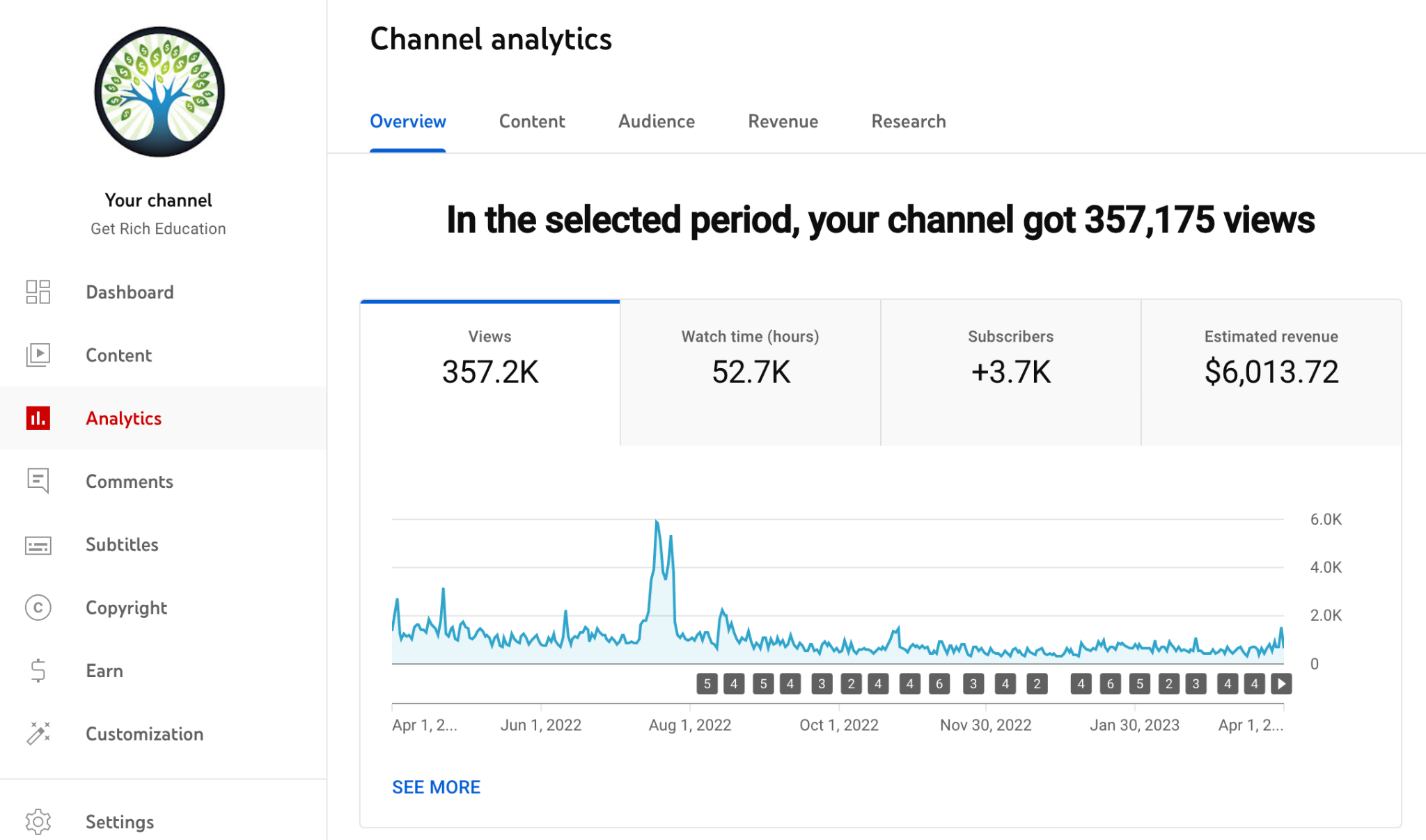
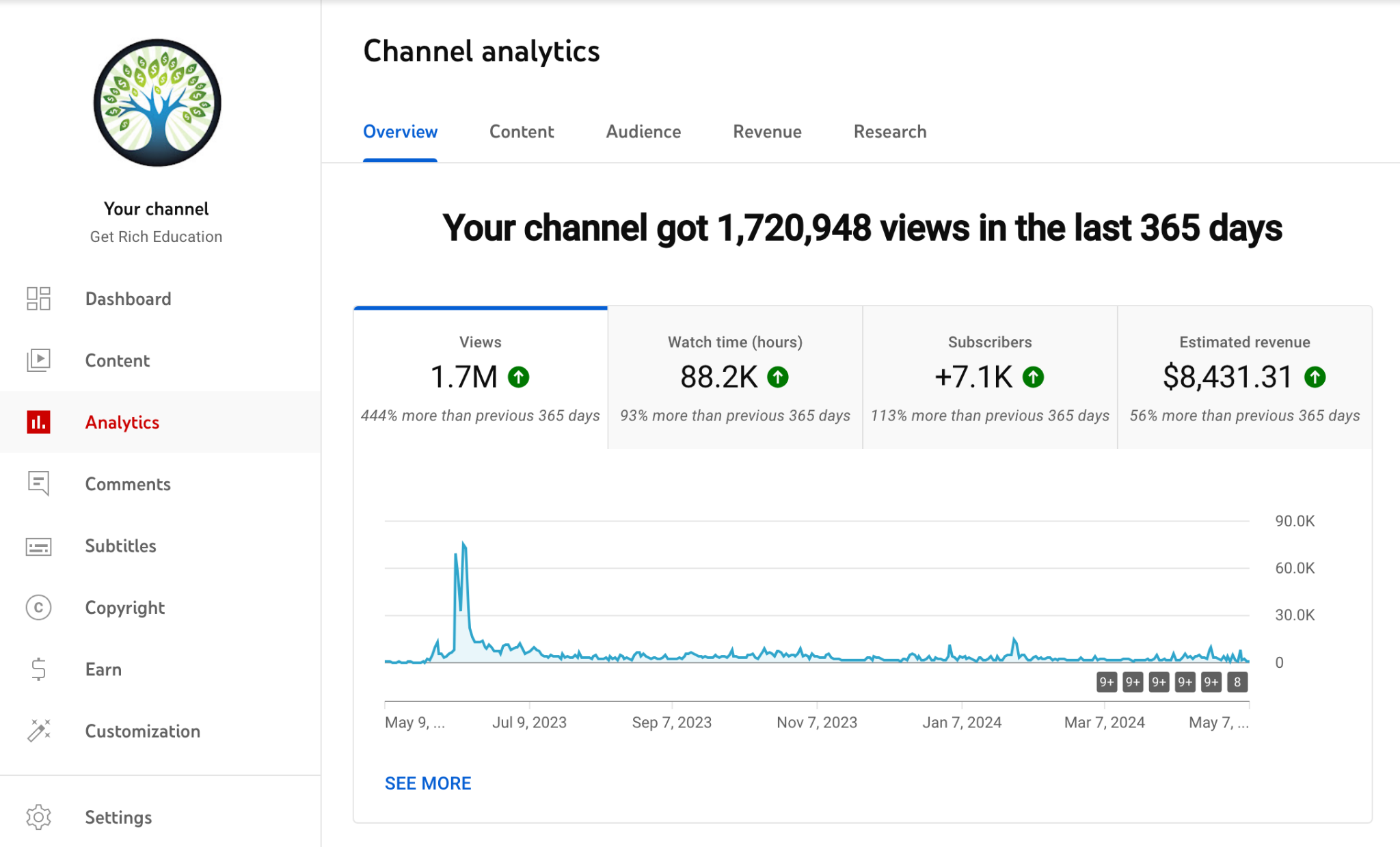
- Get Rich Education (real estate investing education): 1,720,948 views in 12 months working together. Views up 444%, watch time up 93%, subscribers up 113%, revenue up 56%, with no extra work for the host.
- Jacob Shapiro: from 27K views to 2.4M views in 12 months.
Part 2The Packaging Playbook
Titles and thumbnails that give your ideal viewers a reason to watch, for new episodes and the ones you’ve already published.
Why it matters: Viewers decide whether an episode is worth their time before they hear a word. Strong packaging communicates value. It can also give your overlooked back catalogue a second life. That’s free growth from content you already paid to make.
The 3 Plays
- Play 1: The high-conversion thumbnail. Build it around a surprising insight, a meaningful problem, or a desirable outcome. One focal point, strong contrast, and 2–4 words readable on a phone. Pair it with a title that adds context and curiosity, without promising what the episode doesn’t deliver.
- Play 2: Refresh underperforming episodes. Find older episodes with strong conversations and weak packaging. Repackage them around a sharper angle, then re-promote with fresh clips and an email.
- Play 3: The 3-Second Packaging Test. Before publishing, your title and thumbnail must instantly tell the ideal viewer what it’s about, why it matters now, and what they gain.
10 Title Formulas That Work for Business Podcasts
| # | Formula | Example |
|---|---|---|
| 1 | Is [Popular Belief] a Lie? [Guest] Weighs In | Is California About to Collapse? Peter Zeihan Weighs In |
| 2 | Why [Big Event] Is Unavoidable (And [Authority] Can’t Stop It) | Why the US Fiscal Crisis Is Unavoidable (And Scott Bessent Can’t Stop It) |
| 3 | [Number] Mistakes Quietly Costing You [Desired Outcome] | 5 Mistakes Quietly Costing You Your First Rental Property |
| 4 | The Hidden [Thing] [Group] Don’t Talk About | The Hidden Mortgage Strategies Lenders Don’t Talk About |
| 5 | How [Person] Went From [Before] to [After] in [Time] | How a Nurse Went From $0 to 12 Rentals in 3 Years |
| 6 | I Asked [Credible Guest] How to [Dream Outcome] | I Asked a Former CIA Analyst How to Protect My Savings |
| 7 | Stop [Common Action] Until You Hear This | Stop Buying Gold Until You Hear This |
| 8 | [Topic] Is Changing in [Year]. Here’s What to Do Now. | Real Estate Is Changing in 2026. Here’s What to Do Now. |
| 9 | What the Top 1% of [Group] Know About [Topic] | What the Top 1% of Coaches Know About Pricing |
| 10 | [Surprising Result] From [Unexpected Source] | Unboxing $60,000 Worth of Gold Bars From APMEX |
Rule: thumbnail text and title should work as a pair. Never repeat the title on the thumbnail. The thumbnail creates the emotion (“15% INFLATION INCOMING”). The title adds the context.
The 3-Second Packaging Test (Scored)
Score 1 point for each yes. Don’t publish below 6/8.
- Shrunk to phone size, can you read the thumbnail text in under 1 second?
- Is there one clear focal point (usually one expressive face or object)?
- Is the thumbnail text 4 words or fewer, and different from the title?
- Does the title say what the episode is about?
- Does it say why it matters now?
- Does it make clear what the viewer gains by watching?
- Does the episode deliver on the promise within the first 5 minutes?
- Would your ideal client (not just any viewer) click this?
The Back-Catalogue Refresh Process
| Step | Action |
|---|---|
| 1 | In YouTube Studio, sort your episodes by average view duration. List those in the top 30% for retention but the bottom 50% for views. Good content, bad packaging. |
| 2 | For each, rewrite the angle using a title formula above. Ask: what is the most surprising or valuable thing said in this episode? |
| 3 | Design a new thumbnail and run it through the 3-Second Packaging Test. |
| 4 | Swap the title and thumbnail. Record the date and the views per hour before the change. |
| 5 | Re-promote with 2–3 new clips and one email to your list. |
| 6 | After 14 days, compare views per hour and average view duration. Keep what wins and repeat with the next 5 episodes. |
Results from this part
- Get Rich Education, before and after repackaging: old titles like “Be Outraged! You’re being robbed.” earned 428 to 1.5K views. New packaging built on clear, curious angles earned up to 80K.
- Jacob Shapiro: from generic show-branded thumbnails to episode-specific angles.
Part 3The Distribution Playbook
Turn every episode into 15 pieces of content and publish them where your ideal clients already spend time.
Why it matters: Most people will never discover you through a 90-minute episode. But they will watch a 45-second answer to a problem they have today. Repurposing your strongest ideas creates more chances to be found, without recording more.
The 3 Plays
- Play 1: The content waterfall. Pull useful answers, surprising insights, and compelling stories from each episode. Each piece needs a clear opening, enough context to stand alone, and a satisfying takeaway.
- Play 2: Distribute with intention. Prioritise the 2–3 platforms where your ideal clients spend time. Adapt format, captions, and call to action for each one. Batch, schedule, then use the data to improve the next batch.
- Play 3: Assign clear ownership. Someone other than you should own publishing, comments, and performance reviews. One recording should create many chances to be discovered, understood, and moved towards your business.
The 1 Episode → 15 Assets Waterfall
| Asset | Pulled from | Format | Where | Qty |
|---|---|---|---|---|
| Full episode | Edited episode + trailer | 16:9, chapters, custom thumbnail | YouTube, Spotify, Apple | 1 |
| Deep-dive clips (8–15 min) | Two strongest segments | 16:9 with its own title and thumbnail | YouTube | 2 |
| Short clips (30–60s) | Punchy answers, bold claims, stories | 9:16, burned-in captions, hook in first 2s | YouTube Shorts, Reels, TikTok | 6 |
| Text posts | Key lesson or contrarian take | Written post, optional clip | LinkedIn, X | 2 |
| Quote carousel | 5 best one-liners | Image carousel | Instagram, LinkedIn | 1 |
| The episode’s big idea | ~200 words + link | Your email list | 1 | |
| Guest share kit | 3 clips + ready-to-post captions | Shared folder | Guest’s own channels | 1 |
| Newsletter/blog summary | Episode transcript | Short article, links to lead magnet | Website, SEO | 1 |
| Total | 15 |
The Weekly Batch Rhythm
| Day | Who | What |
|---|---|---|
| Monday | Host | Record (1–2 hours). That’s the host’s only production task for the week. |
| Tuesday | Strategist | Watch the raw episode. Mark clip timestamps, trailer moment, and cut-list items. Brief the editor. |
| Wed–Thu | Editor | Edit the full episode, trailer, and clips. Strategist writes titles, captions, and email. |
| Friday | Strategist | Quality check. Schedule all 15 assets across the next 7 days. |
| Daily | Publisher / VA | Reply to comments, flag buying questions and leads to the host. |
Results from this part
- Seth Williams (REtipster, land and real estate investing education): 2.1M views across social platforms from repurposed content.
- Lisa A. Romano (life coach): 2M+ views from repackaging existing long-form videos.
- Our founder’s own account, run on this exact system: from 14.3K to 56.3K Instagram followers. We use it on ourselves first.
Part 4The Monetization Playbook
Turn attention into booked calls by proving your expertise and giving interested viewers a clear next step.
Why it matters: Attention alone doesn’t create customers. People need to understand how you help, trust that you can deliver, and know exactly what to do next. This is the part most business podcasts skip, and it’s the only part that pays.
The 3 Plays
- Play 1: Build a simple podcast funnel. Create content around problems your ideal clients want solved. Point viewers to a free checklist, guide, or template. Follow up with helpful emails, client examples, and a clear invitation to book a call.
- Play 2: Sell without constantly selling. Use episodes to answer real buying questions. Share client stories, before-and-afters, and the decisions behind your work, so viewers understand the value of hiring you without a pitch in every episode.
- Play 3: Invite strategic guests. Invite guests who serve your audience and could become clients or referral partners. Keep the interview genuinely valuable. If a real fit emerges, suggest a separate follow-up conversation.
The Podcast Funnel Map
| Step | What happens |
|---|---|
| 1. Episode or clip | Solves part of a problem |
| 2. Free lead magnet | A checklist, guide, or template |
| 3. 5-email nurture | Sent over 10 days |
| 4. Booked call | With a warm, informed lead |
Rule for your lead magnet: it should solve one narrow problem completely, and in doing so, reveal the bigger problem your paid offer solves.
Copy-and-Paste Scripts
Script A: In-episode call to action (place right after a valuable moment, never at the start)
“If you’re a [ideal client] and [problem we just discussed] sounds familiar, I put together a free [checklist/guide] with the [X] steps we use with clients. It’s free, and the link is in the description. Grab it, because [reason it matters now].”
Script B: Nurture email #1 (sent the moment someone downloads)
Subject: Your [lead magnet] (+ the mistake most people make) Hi [First name], Here’s your [lead magnet]: [link]. Start with step [X]. It’s where most [ideal clients] get stuck, and it’s the one that made the biggest difference for [client name], who went from [before] to [after] in [time]. If you’d rather have us look at your situation directly, you can book a free [call name] here: [link]. No pitch, just a clear plan. [Your name]
Script C: Strategic guest invite (DM or email)
“Hi [Name], I host [Podcast], where we help [audience] with [topic]. Your take on [specific thing they posted or said] is exactly what my audience needs to hear. Would you be up for a 45-minute conversation? We handle all the editing and send you ready-to-post clips afterwards.”
Script D: Post-interview follow-up (only if a real fit came up)
“Loved recording with you. Clips are on the way. You mentioned [challenge they raised] off-air. We’ve helped [your ICP] with exactly that. Worth a separate 20-minute chat? No pressure either way.”
The 90-Second Client Story Segment
Drop one of these into every 2–3 episodes. It sells without pitching.
| Beat | Say this |
|---|---|
| Problem | “A client came to us last year with [specific problem]…” |
| Decision | “Most people would have [common approach]. We did [your approach] because [reason].” |
| Result | “Within [time], [measurable result].” |
| Bridge | “If that’s you, that’s exactly what we do. Link’s below.” |
Results from this part
- Dr. Thema Bryant (psychologist, author, speaker): 4M+ views across platforms from repurposed podcast and YouTube content.
- Mark Bell’s Power Project: 7.2M+ views by repurposing existing podcast episodes.
BonusThe Content Team Playbook
How to reach “Film and Forget”: a small team that turns recordings into finished, published content without you managing it.
Why it matters: Hiring an editor isn’t enough. Someone has to own the decisions: what to clip, how to package it, when to publish. Without that person, the decisions fall back on you, and the podcast becomes a second job.
The Film-and-Forget Team Structure
| Role | Owns | Host’s involvement |
|---|---|---|
| Content Strategist | Topic research, clip selection, titles and thumbnails, publishing calendar, weekly reporting | 30-minute weekly review |
| Video Editor | Full episodes, trailers, clips, captions, thumbnails to brief | None |
| Publisher / VA | Scheduling, quality checks, comment replies, flagging leads | None |
| Host (you) | Recording great conversations and taking sales calls | ~2 hours per week |
Hiring Test Assignments
Content Strategist test (paid, 2 hours)
Send one existing episode. Ask for (1) the 5 best clips/timestamps with a hook line for each, (2) three title and thumbnail concepts for the full episode, (3) one sentence on who this episode would attract as a client. You’re judging taste and business sense.
Editor test (paid, 3 hours)
Send the same raw episode and the strategist’s brief. Ask for one 60-second trailer and two short clips. You’re judging execution, speed, and whether they followed the brief.
For both: score communication and whether they hit the deadline. These predict the job better than the portfolio does.
The 30-Minute Weekly Review Agenda
| Min | Topic | Questions to answer |
|---|---|---|
| 0–5 | Shipped vs planned | What went out? What’s late, and why? |
| 5–15 | Numbers | Click-through rate and average view duration on the full episode. Top 3 clips. Lead magnet downloads. Calls booked. |
| 15–25 | Next week | Which angles and clips next? What do this week’s numbers suggest we test? |
| 25–30 | Feedback → SOP | Any feedback given twice gets written into the team’s playbook so you never give it a third time. |
Self-assessmentThe Podcast Growth Scorecard
Answer honestly. Give yourself 1 point for every yes. Your lowest-scoring part is the biggest thing holding your podcast (and your business) back. Fix that before anything else.
Part 1: Post-Production
- Does every episode open with a trailer built around its strongest moment (not a generic intro)?
- Does the first real insight arrive within 60 seconds?
- Do you run a cut-list to remove tangents, repetition, and tech issues?
- Is your average percentage viewed on full episodes above 30%?
- Do you add chapters and on-screen text where they help understanding?
Part score: __ / 5
Part 2: Packaging
- Is every thumbnail designed for that specific episode (not a reused show template)?
- Is thumbnail text 4 words or fewer and readable on a phone?
- Do your titles say why the episode matters now and what the viewer gains?
- Have you repackaged any old episodes in the last 90 days?
- Is your click-through rate on YouTube above 4%?
Part score: __ / 5
Part 3: Distribution
- Does each episode become at least 10 separate pieces of content?
- Are you posting short clips at least 4 times a week?
- Have you chosen 2–3 priority platforms based on where your clients are?
- Is publishing done by someone other than you?
- Do you review content performance at least monthly and change what you make?
Part score: __ / 5
Part 4: Monetization
- Do you have a free lead magnet related to what you sell?
- Do episodes and clips point viewers to it at least weekly?
- Does someone who downloads it get an automated follow-up email sequence?
- Have you had a sales call in the last 30 days that started from the podcast?
- Do you invite guests who could become clients or referral partners?
Part score: __ / 5
What your score means
| Total | Diagnosis | What to do |
|---|---|---|
| 17–20 | Leak-proof. You’re running a real system. Growth now comes from volume and testing. | Scale output and test new formats. |
| 11–16 | Leaking. The podcast works in parts, but one or two leaks are capping your views and leads. | Fix your lowest-scoring part first. Book an audit if you want a second pair of eyes. |
| 0–10 | Losing most of the attention you’ve already earned. Good conversations are going unseen, and viewers aren’t becoming clients. | This is where the biggest, fastest gains are. Book an audit. |
What Your Podcast Leaks Are Costing You
Fill in your own numbers. Then see what happens when you fix just one leak.
| Step | Illustrative example |
|---|---|
| Monthly views (all platforms) | 50,000 |
| × % who grab your lead magnet | 1% → 500 leads |
| × % of leads who book a call | 5% → 25 calls |
| × % of calls you close | 25% → 6 clients |
| × Value of one client | $5,000 |
| = Monthly revenue from your podcast | $31,250 |
| Fix one leak | Example result |
|---|---|
| Better packaging doubles views (50K → 100K) | 12 clients → $62,500/month |
| A lead magnet CTA in every episode doubles opt-ins (1% → 2%) | 12 clients → $62,500/month |
| Fix both | 25 clients → $125,000/month |
Figures are illustrative, not a promise of results. The point: each leak multiplies the others, so small fixes in two places can quadruple the outcome.
Frequently Asked Questions
A free 24-page playbook from Wisee Media that shows business owners how to turn one podcast recording a week into views, qualified leads and clients. It covers four parts — post-production, packaging, distribution and monetization — plus a content-team playbook and a 20-question Podcast Growth Scorecard.
Your next stepBook Your Free Podcast Growth Audit
Scored under 17 on the Scorecard? On a 45-minute call, we’ll review your podcast live and show you exactly where it’s losing views, attention, and clients.
What you walk away with (free, yours to keep)
- Your 3 biggest retention leaks, with timestamps from your own episodes
- 10 back-catalogue episodes worth repackaging, with new title and thumbnail angles
- Your content waterfall gaps: which platforms and formats you’re missing
- A 90-day plan to turn your views into booked calls
Every audit is done by our senior content strategist, not a template, and we only onboard 2 new podcasts per month so every show gets a dedicated team. Best fit: business owners with 25+ episodes and an offer worth $2,000 or more.
We Guarantee 1 Million Views for your Podcast in a Year… or we work the next 6 Months for free.